
Welcome to Sunday’s Idea Brunch, your interview series with great off-the-beaten-path investors. We are very excited to interview Francisco Amador!
Francisco is currently a Managing Director at Arqos Capital, an investment firm focused exclusively on Venezuela investing across private equity, venture capital, and real estate. Before joining Arqos in May 2026, Francisco was a senior investment analyst at Harspring Capital, a fundamental L/S hedge fund where he focused on global consumer, music and technology investing. Francisco is also the founder of Sleepwell Capital, a private investment vehicle and content platform focused on consumer, music, tech and experiences across public and private markets.
Francisco, thanks for doing Sunday’s Idea Brunch! Can you please tell readers a little more about your background, Sleepwell Capital, and why you decided to join Arqos Capital?
I’m honored to be here.
I grew up in Caracas, Venezuela and moved to the US when I was 18 to go to college in Massachusetts. While I was majoring in engineering, I quickly realized I wanted to work in finance, and more specifically focus on investing after playing around in the stock market with a small inheritance (mostly a failed experiment).
I managed to get a job in JPMorgan where I worked for six years, first in the Private Bank and then in Fixed Income and Credit Research. I then moved into Equity Research at TD Cowen covering industrials, automation and robotics.
During the pandemic I created the pseudonymous account Sleepwell Capital on Twitter and started posting about stocks. After gaining a bit of a following, I decided to try to find a job on the buyside by posting my anonymized resume. To my surprise it worked. I interviewed at a few different funds and ended up at Harspring Capital, a L/S fundamental hedge fund. It was a dream job; I could look at any company I wanted to in any sector that interested me working with people that I admired and were smarter than me. I covered consumer, tech, music and financial services.
I spent four and a half years at Harspring. Early this year the firm went through some organizational changes and ultimately it didn’t make sense for me to stay there. Coincidentally, this happened just a few weeks after January 3rd – a date that Venezuelans will forever remember – when Nicolas Maduro was removed from office by US forces.
Over the following weeks and months, I began an exploratory journey to find what I should do next. During this process, I realized that Venezuela could potentially be a once in a lifetime investment and career opportunity.
Historically, when a country that has been closed from the rest of the world under an authoritarian regime undergoes a transition into an open-market democracy, investment opportunities can be highly attractive for those that are best prepared and are willing to invest in the early phase of the transition. This happened in Poland, Russia, Peru and Vietnam.
After appreciating how difficult it is to differentiate and find an edge in the public markets, I became convinced that I was in a fortunate position to capitalize on this opportunity. I had the Venezuelan background, the skillset of investing professionally for over 10 years and this was a market that institutional capital couldn’t go after. This led me to make my first Venezuela investment in Yummy – Venezuela’s leading ridesharing and SuperApp – where Arqos Capital happened to be leading an investment round.
After learning more about Arqos, I was surprised to see that they had been investing institutional capital exclusively in Venezuela since 2019 (practically by themselves). I was intrigued and decided I wanted to get to know them better. I started chatting often with Daniel Rottenberg, the Founder and Managing Partner. When I told him one day I was considering potentially launching my own Venezuela fund, he suggested I should join him instead and help them build their Private Equity and Venture efforts. This quickly became a no-brainer career decision for me as it gave me the opportunity to be the driver seat at one of Venezuela’s most established and reputable institutional funds.
For readers who have never been to Venezuela, can you give us a sense of what the country and culture are like right now? Why is now a good time to be bullish on Venezuela?
Venezuela is a gorgeous country. Venezuelans are warm, friendly, humorous and resilient. Caracas, the capital, is a beautiful city, located in a valley with a large mountain range to the north, which separates the city from the coast.
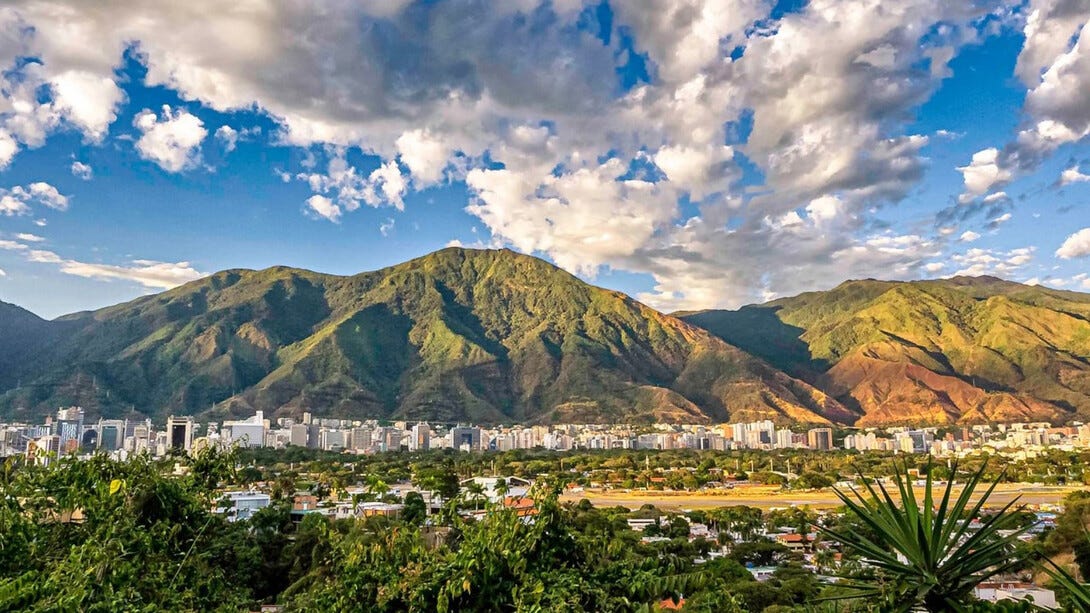
You can feel an optimistic energy in the city now as people have become hopeful that positive change has already arrived. There is still a long road ahead though, and much of the country is still living in very dire conditions.
I’m incredibly bullish on Venezuela because for the first time in two decades, we are in the early stages of a transition to a democratic and markets-oriented regime. If this transition goes through successfully, Venezuela is likely to experience a prosperous decade of double-digit GDP growth and recovering from a crisis that has hit the country and its people very hard.
How is Venezuela today different than the one you grew up in and left in 2009?
The country has changed in many ways. Over eight million people left, many of these represented some of the best young talent the country had. The country went through its worst economic crisis with hyperinflation, food shortages, electricity outages and a GDP that declined 75% peak-to-trough. A lot of companies have been through a period of underinvestment, many of them were expropriated or nationalized, others left, and a lot of assets are dilapidated. There’s been little new construction or infrastructure projects built. Not much innovation has taken place and competition has been very limited in most industries, which has made many companies complacent.
I think Venezuela is entering a major recovery and reconstruction phase. Opportunities abound in practically any sector you look at. It’s a blank canvas.
What external signs or pieces of information should outsiders be looking for to measure positive progress in the country?
The best leading indicator today is probably oil production. For context, Venezuela produced between 3-3.5 million barrels p/day at its peak. That declined to the 700 thousands and now it sits around 1.2M after recent investments in the sector. As more investment keeps coming, this number is likely to increase and should have a trickle-down effect on the rest of the economy including employment, GDP growth, and investments into other sectors like electricity, infrastructure and tourism for example. It’s very important that oil revenues get re-allocated properly by the government.
Another important piece of information to track is the progress of the democratic transition. There’s a lot of noise now, and ultimately the US is working towards democratic elections, but before those get announced there’s a few important developments that need to take place. These are the reform of the National Assembly, the Supreme Court and the National Electoral Council. These three institutions need to regain credibility to hold legitimate and fair elections. It’s possible that State and Municipal elections take place before the Presidential Election, something else to watch out for. But the biggest catalyst will certainly be the Presidential Elections, something I think will happen in the next 2 years or so.
The final piece of information I’m looking out for is foreign investments, specifically outside the oil sector (which has seen most of the activity so far). For example, any large M&A transactions or foreign companies announcing that they intend to come back into the country.
What do you think are the biggest risks to the Venezuela investment thesis? What could go wrong over the next few years?
Any political transition is not without risks. The biggest risk is that the US suddenly decides to abandon its commitment to a democratic transition and support for Venezuela, leaves the country and the socialist regime retakes power via military coup or something similar. If we’re using analogs, this is the Myanmar example, or Afghanistan after the US left.
I think this is very low probability and I consider it a tail risk, but it’s a risk none the less. It also becomes less likely each day that goes by as the socialist party is losing relevance and their institutions are being dismantled and key members removed from power positions. My base case is that the US wants a full democratic transition, as it’s in their best interest. They want to keep democracy, stability and strong allies in the Western hemisphere. And of course, the fact that the US is now directly involved in the O&G sectors gives them yet another reason to stick around. Incentives matter a lot here.
That said, I’m certainly not a political analyst.
How does your investment research process in Venezuela differ from your research process in more developed markets? What can you only learn by being on the ground?
It’s night and day. At Arqos, we are mostly focused on private investments, as there is not much to do in the Caracas Stock Exchange (trades ~$200K per day!). This means that there are no screening tools, annual reports, investor days or expert calls to swift through. There is little reliable information online. Everything is done manually, on the ground, and leveraging the local network. We source deals by talking to businesses, bankers, lawyers and asking around in our social circles.
When we start to diligence a deal, in many cases the company doesn’t have the information we require so we need to involve an accountant, auditor or lawyer. We make on site visits to stores, warehouses, manufacturing plants and ask industry experts about a specific company and its competitors as well as talking to its employees. In many cases we need to create new entities and figure out the best structure and governance is for each deal. You also need to be highly confident and comfortable with who you’re partnering with, given the reputational risks involved.
I think it’s important to be Venezuelan and be on the ground to invest successfully in Venezuela. It’s a very peculiar place, with lots of local nuances, complexities and customs. You must understand how business is done, how the government and regulators behave, and what the people are like. I’m still learning and getting familiar with the universe of companies here, as I’ve been away for 17 years, so it helps a lot to be here while I build the pipeline of attractive opportunities. There are also financial complexities coming from a dual exchange rate system and hyperinflation accounting, it’s taken me some time to get used to this coming from reading 10-Ks in dollars.
Contrary to what some people believe, great investment opportunities are difficult to come by in Venezuela. First, because there wasn’t ever really much distress since there’s no leverage in the system – credit represents only 3% of GDP as opposed to 50-60% average in the Latam region. Second, because most business-owners are already rich – Venezuela was a very prosperous country in the second half of the 20th century – so people have very little reason to sell their businesses. This makes deal sourcing very difficult and is yet another reason why being on the ground with a vast network and good reputation is so important. The best deals typically come off market, and you need to build trusted relationships with business owners, which takes a long time and cannot be done over a Zoom call.
Who are some of the operators you admire most in Venezuela? Generally, do you find that management teams act in the best interests of shareholders?
Two of the largest companies are very well managed and broadly admired. Polar is the local beer producer, Pepsi bottler, and food conglomerate and Farmatodo is the largest pharmacy chain (inspired by CVS/Walgreens). These companies doubled down in the country during the worst times and that bet has paid off today as they sit in a strong competitive position. They also sell to the entire population, so their brands are very strong.
In the tech and startup space, Cashea (BNPL) and Yummy (Ridesharing/SuperApp) are the two largest companies and consumers love them. They have an incredible track record of achieving national scale quickly, founded under very difficult conditions and operating at a very high level. They also know Venezuelans deeply well and adapt to their needs. There are a lot of smaller startups that are also executing well with a very strong talent bench and trying to solve some of the most important problems in Venezuela.
The treatment of minority shareholders very much depends on the company, a lot of the family-owned businesses have been owned by multiple generations and are not used to dealing with minority shareholders, so this can create tension. Younger companies are more modern and shareholder friendly as they understand that they depend on good relationships with their capital providers who themselves require certain protections, assurances and a voice in the company’s strategy.