
Welcome to Sunday’s Idea Brunch, your interview series with great off-the-beaten-path investors. We are very excited to interview David Katunarić!
David is a Croatia-based investor who writes The Mikro Kap, a research publication focused on global micro-caps and deeply underfollowed stocks. David began sharing ideas online in 2023 and launched his publication full-time in 2024 after leaving an equity research role. David is active @david_katunaric on X and his portfolio is up 176% from January 1, 2023, through the end of Q1 2026.
David, thanks for doing Sunday’s Idea Brunch! Can you please tell readers a little more about your background and why you decided to launch The Mikro Kap?
Let’s start way back. My first encounter with the word “stock” came when I was about 10 years old and went to a store to pick up Harry Potter and the Deathly Hallows. I overheard someone talking about stocks and asked my mother what a stock was. Although she is an architect, she was financially literate enough to explain that by buying a stock, you could own a piece of a business you liked. I told her I wanted to buy shares in Algoritam, one of the largest bookstore chains in Croatia and the place where I had bought my Harry Potter book. Algoritam was not publicly listed, but it did file for bankruptcy a few years later. Quite the talented young analyst I was, right?
The reason I share this story is that my actual background is quite boring and follows the kind of textbook path often seen in value investing. The first investing book I read was, of course, The Intelligent Investor. And no, I did not find it boring at all—it clicked immediately. I wanted to analyze businesses, not charts, and I wanted to pay much less than a business was worth.
While I do have some formal background in investing, including a Master’s degree in Corporate Finance and experience as an equity analyst at Croatia’s largest independent asset manager, I do not like to emphasize it online because I do not think it shaped my investing style or helped my track record. If anything, it shaped me by showing me what NOT to do. It gave me a firsthand look at many of the things you read about in books: how incentives in a typical institution are often structured in ways that encourage short-term thinking, subpar decision-making, a focus on the “wrong” parts of the market, and ultimately below-average performance.
Even before I quit my job, what worked for me was focusing on underfollowed corners of the market—areas where you cannot borrow conviction and have to do the work yourself to understand how good or bad the setup really is, and where you are not competing directly with firms that have far larger research budgets.
It was a lonely journey before I started my Twitter and Substack, because the investing community in Croatia is small, the value investing community is even smaller, and once you narrow it further to micro-caps, there was effectively no one to talk to about stocks.
Substack became a way for me to better organize my thoughts around ideas I believed were worth investing in, get pushback on things I had overlooked or misanalysed, and ultimately build a circle of like-minded investors who could bounce ideas off one another.
With some luck, that step has turned out well for me. These days, I probably get just as many ideas from texting with friends I admire, who have a strong eye for a micro-cap bargain, as I do from A-Z research. And there was a time when A-Z research was almost all I did.
I was also fortunate that, while I was still writing for free, a number of people chose to financially support the publication even though they were not getting any content that free subscribers did not already receive. Their support made me think that perhaps I could do this full time, and it ultimately gave me the push to turn The Mikro Kap into a full-time venture.
Can you tell us a little more about your research and investing process?
I’d start by saying that I don’t really believe in a fixed research “process” or investment “strategy.” In my view, limiting yourself to buying or researching only a certain type of opportunity won’t make you a great investor.
It may give you a framework, and those boundaries are sometimes useful, but they are also limiting. That helps explain why many of today’s famous growth investors struggled in the 2000s, and why many historically (seemingly) great value investors have lagged the S&P since the GFC: they did not adapt. There are no proven rules in this game. And if there were, Mr. GPT could simply run through a checklist, and I would have no edge—or a reason to write a Substack.
That said, there are a few principles I place a high value on, even if I remain open to breaking them:
Illiquidity. I like under-followed companies and obscure setups where I’m not trying to outsmart or compete with “professional investors,” but instead be early to something they’re not yet paying attention to.
Downside protection. I strongly believe that buying things well matters more than buying good things.
A clear path to value realization—accelerating growth, improving capital allocation (used to be my main focus), or material corporate actions that eventually force the market to agree with my valuation work.
Doing deep enough work to be confident in points 1–3, and to know that a lot has to go wrong for the investment not to work out.
At the risk of a shameless plug, and in the interest of not taking up too much of the reader’s time with philosophical reflections they may not care about, I’ve explored this in more depth in my “My Life in Value” article, which is available for free on my website.
To contradict myself a little, though, I would say there are two evergreen truths that can give almost anyone an edge when fishing in micro-cap waters. The first is curiosity—something Greenblatt captures particularly well in his special situations class, on page 245:
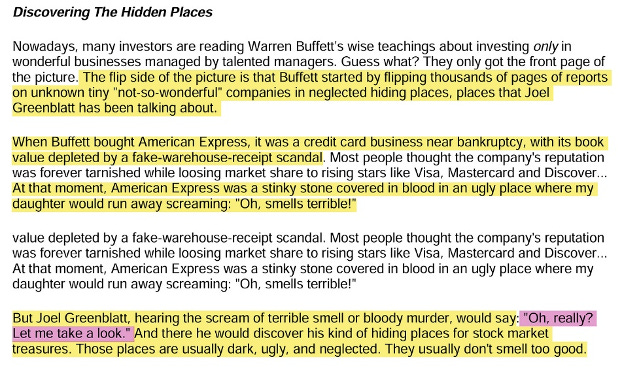
“Oh, really? Let me take a look.”
The second is attention span—the ability to research diligently.
So if I had to describe my investing process in a single sentence, it would be this: read, read, read, pass quickly on most ideas, and keep going until something good, cheap, or unusual makes me say “huh?” out loud, at which point I dig deeper to figure out what the “anomaly” is really about.
Opening my eyes to what might be an opportunity on my desk, then doing the detective work needed to figure out what actually matters and how that shapes the risk-reward of a given investment. Ultimately, building enough conviction to decide whether to pass, follow along, or make the bet at the appropriate size.
You have said you like markets where others cannot or will not fish. Which markets or exchanges today are most mispriced to you?
First, I would say that most of one’s edge should come from exploiting single-stock inefficiencies rather than broader market inefficiencies. And IMO the best way to do that is by constantly exchanging ideas with investors you admire and by keeping a close eye on as many stocks as possible that you have already done proper work on. Across any market.
That said, if I had to single out one area today, I would say that Japanese micro-caps are currently the most attractive pocket of the market for investors willing to roll up their sleeves and flip the rocks from A to Z.
Most investors don’t know that Japan, not the U.S., is the market with most publicly listed profitable micro-caps. If you do a simple screen, targeting companies with below 300M USD market cap and with LTM EBITDA of more than 0, your end result will be 762 companies in the U.S. that fit that criteria and 2130 companies in Japan. Almost 3x higher.
Thanks to lack of (proper) private equity competition, less regulatory and financial burden than the U.S. these companies are of higher quality than in U.S. and are not just there to overpromise to investors and dilute the heck out of them. Thanks to less sophisticated local capital markets and foreign competition that finds it hard to overcome language and cultural barriers , these companies tend to trade at a lower multiple.
And thanks to the Tokyo Stock Exchange, the biggest historical weakness of many Japanese companies—their capital allocation—is improving for the better. About three years ago, the TSE began publicly shaming companies that were hoarding too much cash on the balance sheet and failing to generate returns high enough to cover their cost of capital, whether in terms of ROE versus the cost of equity or ROIC versus WACC.
As a result, there is now a higher likelihood that many of these companies will be pushed to improve capital allocation and be re-rated accordingly, making Japan a progressively more shareholder-friendly market over time.
Not to shame them, but I found Japanese investors as probably most short-term oriented and mostly only valuing companies based on P/E, which means there are a lot of inefficiencies that one can take advantage of. It is a case by case basis but I am indeed finding a lot more value there than in other markets in the moment and have initiated two positions there since the beginning of the year.
So, in summary, this combination of a larger opportunity set, higher average quality, cheaper valuations, and less competition from “sophisticated” investors makes me feel good about allocating a significant amount of my time to Japan.
What are some interesting ideas on your radar now?
Let me share a compelling mid-sized U.S.-listed company I currently own that may be compelling to your readers.